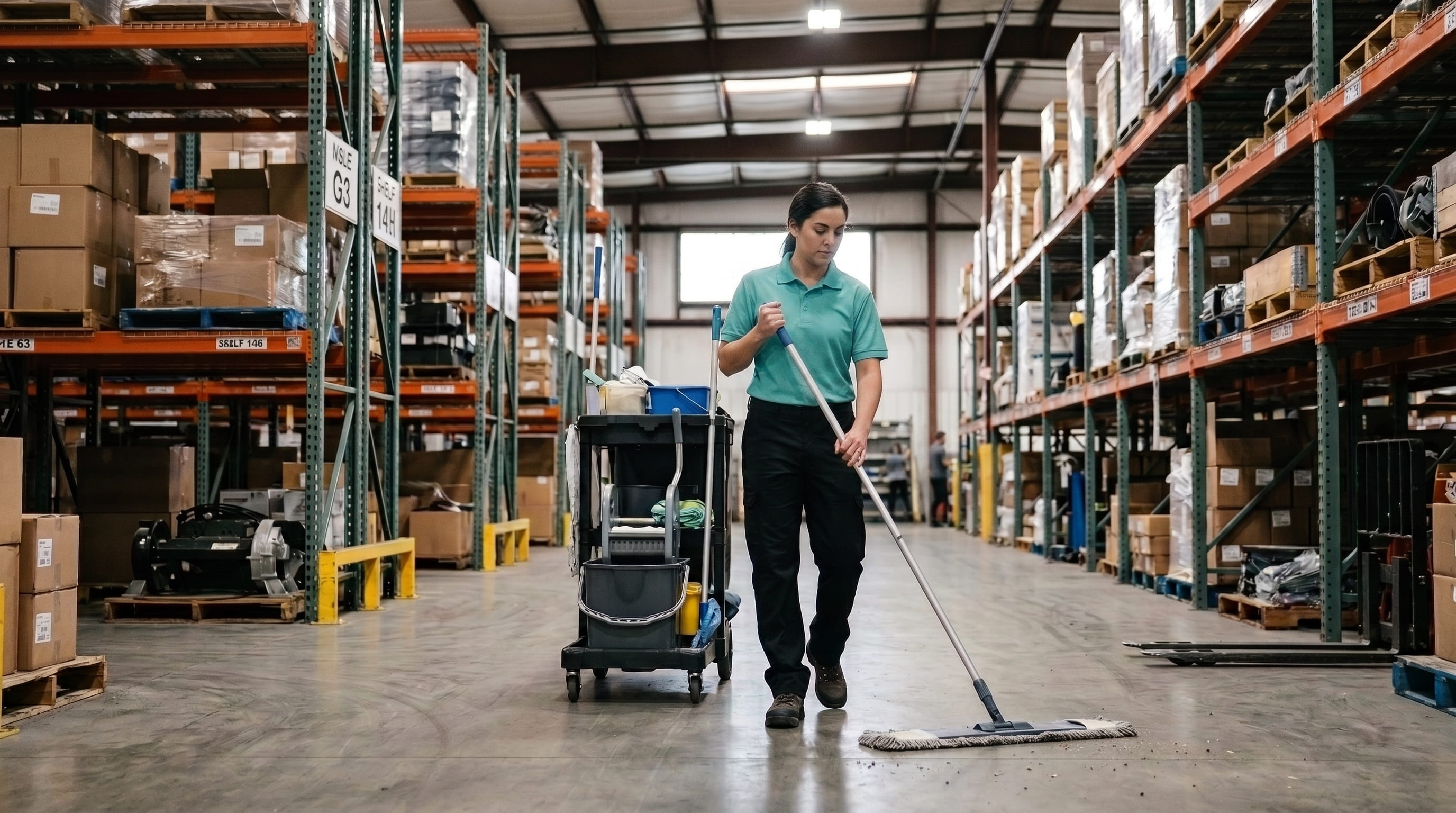
Industrial and Warehouse
Industrial and Warehouse Facility Cleaning in Minneapolis
Large-area floor care, dust control and support-space cleaning for warehouses, distribution centers and light industrial facilities across Minneapolis.
Overview
When Warehouse Housekeeping Becomes an Operating Issue
A busy warehouse can look acceptable from the office door while the operating floor is slowly becoming harder to manage. Forklift traffic redistributes dust and packaging debris through travel lanes, dock doors bring in moisture and grit, and accumulation on racking or ledges eventually makes its way back down to inventory and work surfaces. When line markings become hard to see or a dock lane collects debris, the issue is not cosmetic. It complicates day-to-day movement and leaves more housekeeping problems for the next shift.
Minneapolis Janitorial builds the program around where equipment moves and when the floor is available. We identify travel lanes, docks, staging areas, racking, support spaces, and the office suite, then assign machine scrubbing, sweeping, high dusting, and restroom or break-room service to the conditions in each. The schedule is set around shift changes and safe access windows rather than an assumed empty building. That gives facility managers a usable scope for controlling dust and maintaining the spaces people work in without disrupting active operations.
Scope of Work
What an Industrial Cleaning Program Covers
Industrial cleaning covers three distinct problems: the floor, which is a safety and product-cleanliness asset; the elevated surfaces, where dust accumulates until it falls somewhere it should not; and the support spaces your workforce actually lives in during a shift. Your written scope addresses all three, sets machine scrubbing frequencies against your real traffic levels, schedules high-level dust work on a cycle, and defines how the crew works around shift patterns and active production areas.
- Large-area floor machine scrubbing on defined frequencies
- Aisle and travel lane sweeping and debris removal
- Line marking and floor safety striping cleaning
- Racking upright and beam ledge dust removal on a cycle
- Overhead structure and high ledge dusting where accessible
- Loading dock floor sweeping and debris clearing
- Dock leveler pit debris removal and edge cleaning
- Dock door track and threshold cleaning
- Staging and shipping area floor care
- Pallet and packaging debris collection and disposal
- Trash and recycling collection with liner replacement
- Break room counter, sink, table and appliance exterior cleaning
- Microwave and refrigerator exterior cleaning, interiors on a set cycle
- Vending area cleaning and surrounding floor spot care
- Locker room and changing area cleaning
- Restroom fixture disinfection, restocking and floor scrubbing
- Attached office suite cleaning and carpet vacuuming
- Shipping office and dispatch station surface cleaning
- Entry mat service and seasonal salt and grit removal
- Interior glass, partition and safety mirror cleaning
Our Approach
How We Schedule Cleaning Around Warehouse Operations
Industrial cleaning succeeds only when the work can safely reach the areas that collect soil. Minneapolis Janitorial reviews equipment routes, dock activity, floor access, racking, and shift timing before setting a schedule. That lets machine work, dust control, and support-space service fit the operation instead of creating another obstacle during a working shift.
Assess Floor Load and Access
We walk the facility during operating hours to see traffic volume, forklift routes, debris sources and which areas can realistically be cleaned without stopping work. Access constraints drive the whole schedule.
Match Equipment to the Slab
Scrubbing frequency and machine selection are set against the actual floor area, traffic level and soil load, then written into the scope. Large slabs are not a mop-and-bucket problem regardless of budget.
Work Around Shift Patterns
Crews are scheduled into shift changes and quiet windows so cleaning does not interrupt production or create a hazard around moving equipment. Timing is agreed before service starts.
Verify Floors and Elevated Surfaces
Supervisors inspect floor condition, aisle clearance, dock areas and dust accumulation on racking. Elevated surfaces are checked on their cycle rather than only when someone complains.
Scale With Operational Change
Volume swings, new lines, seasonal peaks and layout changes all alter cleaning demand. The scope is revised in writing so the program keeps pace with the operation.
Benefits
What Facility Managers Get From the Program
Warehouse cleaning supports the operating floor when it keeps travel lanes, docks, and support spaces from becoming a recurring catch-up task. A defined program gives managers a way to schedule floor care around equipment, control dust before it moves to inventory or offices, and maintain the break rooms and restrooms used on every shift.
A Floor That Supports Safety
Clear aisles, visible line marking and debris-free travel lanes reduce a real category of incident risk, and they hold up when someone walks the floor unannounced.
Dust Controlled Before It Reaches Product
Racking and ledge dust is removed on a cycle rather than after it has settled on inventory or triggered an air quality complaint from the attached office.
Support Spaces Your Crews Respect
Break rooms, locker rooms and restrooms held to a genuine standard affect morale and retention in a way that is easy to underestimate.
Cleaning That Does Not Stop Production
Schedules are built around shift changes and quiet windows, so the program adds no friction to the operation it is supporting.
More Facility Types
Other Industries We Clean in Minneapolis
Request a Quote
Request an Industrial Cleaning Quote for Your Minneapolis Facility
Industrial facilities are quoted badly more often than any other building type, because a square-foot number tells you nothing about soil load, forklift traffic or how much of the floor can actually be reached during operating hours. We will walk your facility during a working shift, assess the slab, dock areas, racking and support spaces, and write a scope with machine scrubbing frequencies matched to real traffic and a high-dust cycle scheduled in advance. You will get crews working around your shift patterns rather than through them. Call (612) 712-8785 to arrange a walkthrough.